
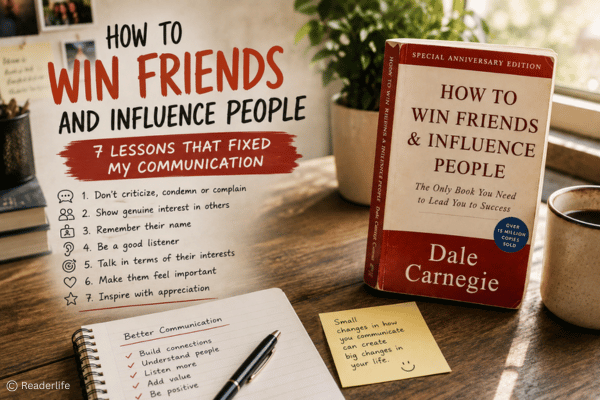
I used to think I was born a bad communicator. Then one book — How to Win Friends and Influence People by Dale Carnegie — showed me the real problem: I was too focused on myself. Here’s exactly what changed, and how you can use the same shifts in your own conversations starting today.
Quick Answer
How to Win Friends and Influence People isn’t really a book about “tricks” to sound smarter. It’s a guide to caring about people first — through listening, genuine appreciation, and empathy. Below are the 7 lessons that personally rewired how I talk, listen, and connect, plus the unexpected side effect nobody warns you about: you become less self-conscious, not more confident on stage.
Table of Contents
Why I Thought I Was a Hopeless Communicator
For years, I labeled myself an introvert who was simply “bad with people.” Before meeting anyone new, my brain ran the same anxious script:
- What should I say?
- What if there’s an awkward silence?
- What will they think of me?
- What if I run out of things to say?
Sometimes I’d rehearse responses in my head while the other person was still talking. Sometimes the words just wouldn’t come at all. I assumed this was permanent — a personality trait, not a skill gap.
Then I picked up How to Win Friends and Influence People, and it offered a different diagnosis: I didn’t need to become louder or wittier. I needed to become more interested in the person standing in front of me. That single reframe was the start of everything else in this post.
1. Unnecessary Criticism Sticks Longer Than You Think
The first lesson that landed hard: stop the throwaway criticism.
I used to assume harsh words faded fast — a quick apology and everyone moves on. They don’t. The person who says something cutting often forgets it within the hour. The person who hears it can carry it for years.
Now, before I criticize anyone, I run it through a quick filter:
- Is this actually necessary?
- Will it fix anything?
- Could I say it more respectfully?
- Am I trying to help, or just venting?
This isn’t about swallowing honest feedback — feedback matters. It’s about cutting the criticism that only exists to make you feel better for two seconds while costing someone else’s trust. One of the sharpest communication tips in How to Win Friends and Influence People is this: sometimes, staying quiet is the kinder move.
2. Flip the Conversation to Their World, Not Yours
This was the biggest shift in me, full stop.
I used to walk into every conversation thinking: What should I say? How do I make my point? What story do I tell? It was all “me.” But everyone you talk to is carrying an entire world you can’t see — their worries, ambitions, wins, and struggles.
So I started asking one different question: What matters to this person right now?
That single question does more for a conversation than any clever opening line. Instead of trying to sound interesting, I got curious about being interested. And here’s the part nobody tells you: curiosity is easier than charisma. You don’t have to perform when you’re genuinely paying attention.
3. Hearing Someone Isn’t the Same as Listening to Them
Before this book, I “listened” the way most people do — just long enough to load my next reply. My ears were open; my brain was already drafting a response.
That’s hearing, not listening. Real listening means giving someone your full attention long enough to actually understand them.
A few habits I built:
- Let them finish the sentence. Don’t jump in.
- Skip the urge to redirect the story back to yourself.
- Notice one specific detail they mention.
- Ask a follow-up question about that detail.
Example: someone says, “I’ve been buried in a new project at work.” Instead of immediately talking about my own workload, I ask, “What’s the project about?” or “What’s the hardest part of it?”
Small questions like these prove you were actually paying attention — and they hand you the next topic for free. You stop having to “carry” the conversation solo.
4. The One Habit That Killed My Pre-Conversation Nerves
As an introvert, approaching a stranger used to feel like walking on stage with no script. My brain would spiral: What if this is awkward? What if I run dry?
The fix, borrowed straight from Dale Carnegie’s classic: before you speak to someone, find one thing you can genuinely appreciate about them. Their skill, their calm energy, the way they explain something, their work ethic — anything real.
Then say it, plainly and honestly:
- “You explain that really clearly.”
- “You handled that so calmly.”
- “You clearly know this topic well.”
The key word is genuine. This isn’t flattery — flattery is praise you don’t mean, used to get something back. Real appreciation is just noticing something true out loud.
The moment my focus shifted from “what will they think of me” to “what can I appreciate about them,” the nerves dropped. Confidence, it turns out, isn’t built by focusing harder on yourself — it’s built by focusing on someone else.
5. A Smile Does the Talking Before You Say a Word
It sounds almost too simple to matter, but a genuine smile changes the temperature of a conversation before it even starts.
Before reading this book, I never thought about my expression when meeting someone. Afterward, I made a small, deliberate effort to smile more naturally. Not every time did I get an instant reaction — but over repeated interactions, people visibly relaxed around me faster. Their body language softened. They smiled back.
A real smile signals friendliness, openness, and respect — no exaggeration required. Most good conversations start before the first sentence is spoken.
6. Remembering Someone’s Name Is a Tiny Act With a Big Payoff
Dale Carnegie’s most quoted lesson might be the simplest: remember people’s names.
I underestimated this for years. Compare these two lines:
- “Can you help me with this?”
- “Mike, can you help me with this?”
The second one lands differently. It says, without extra words, “I remember you. You matter enough to notice.”
A quick trick if names slip your mind easily:
- Repeat it once when you hear it: “Nice to meet you, Priya.”
- Attach one detail: “Priya works in marketing.”
- Use it naturally again before the conversation ends.
Don’t overuse it — that reads as forced. Used sparingly, though, it’s one of the fastest ways to make someone feel seen.
7. Talk About What They Care About, Not What You Want to Say
I used to think a “good conversationalist” was someone with plenty of interesting things to say. Now I think it’s someone genuinely curious about what the other person cares about.
If they light up about their work, ask about it. If they mention a rough week, listen before jumping to advice. If they share a win, acknowledge it before moving on.
This isn’t about faking interest — people can always tell. It’s about staying open to someone else’s world instead of steering everything back to yours.
Here’s the strange part: the awkward silences I used to dread almost disappeared once I did this. I stopped hunting for the next topic because the other person kept handing it to me. And after they felt heard, they usually turned around and asked about me too — my work, my week, my opinions. People open up to you faster once they feel you’re genuinely interested in them first.
The Unexpected Benefit: I Became Less Self-Conscious, Not More Confident
Here’s what surprised me most. I thought better communication meant sharper stories, quicker comebacks, more words. Instead, I got more comfortable the moment I stopped treating every conversation like a performance review of myself.
- Focused on myself → nervous.
- Focused on understanding them → curious.
- Focused on impressing them → self-conscious.
- Focused on listening and appreciating → present.
Communication, it turns out, isn’t only about talking better. It’s about paying better attention.
What Other People Started Noticing
Personal growth isn’t only about how you feel — it’s also about how people experience you. As I practiced these ideas from Carnegie’s book, family, colleagues, and friends started treating me differently. People came to me more often for advice. They seemed to trust me faster. I started hearing words like “mature,” “approachable,” and “easy to talk to” — words I never expected to describe myself.
None of it came from a magic script. It came from repeating small behaviors:
- Listening without interrupting
- Smiling more naturally
- Remembering names
- Skipping unnecessary criticism
- Giving honest appreciation
- Getting curious about other people’s interests
The Core Lessons From How to Win Friends and Influence People
If I had to compress the entire book into one list, it would be this:
- Skip criticism that doesn’t help anyone.
- Give sincere appreciation, never empty flattery.
- Get genuinely interested in other people.
- Listen to understand, not to reply.
- Remember people’s names.
- Talk about what matters to them, not just to you.
- Lead with empathy before you try to make your point.
None of this clicked into place overnight, and I still slip up. I still overthink a conversation sometimes. The difference is I notice it now — and noticing is what gives you room to improve.
Also read: Speak Ill of No One: The Quiet Discipline That Reveals True Maturity
My Biggest Takeaway: Communication Isn’t About Talking More
When I first opened How to Win Friends and Influence People, I thought I was collecting communication “techniques.” I see it differently now. A smile isn’t a technique. Remembering a name isn’t a technique. Listening carefully isn’t a technique. They’re just respect and empathy, expressed in small, repeatable ways.
I used to think my problem was not having enough words. The real problem was having too much focus on myself. The question that changed everything wasn’t “What should I say?” It was “What can I understand, appreciate, and learn from this person?”
That question still runs in the background of every conversation I have. And that’s probably why, even after re-reading this classic three or four times, I still find something new in it each time.
FAQ: Quick Answers About How to Win Friends and Influence People
Is How to Win Friends and Influence People still relevant today?
Yes. The book was first published in 1936, but the core ideas — genuine interest, active listening, honest appreciation — describe how humans respond to each other regardless of decade. If anything, in a world of texting and quick reactions, these habits stand out more, not less.
What is the main lesson of How to Win Friends and Influence People?
The central idea is simple: people respond to genuine interest and respect, not to cleverness or self-promotion. Listening well, remembering names, giving honest appreciation, and avoiding needless criticism matter more than having the “right” thing to say.
Can an introvert actually use these lessons?
Yes — arguably introverts have an advantage. Most of the book’s advice rewards listening and observing over performing, which plays to an introvert’s natural strengths rather than against them.
How long does it take to see results after applying these ideas?
Small shifts, like smiling more naturally or asking one good follow-up question, can change a single conversation immediately. Bigger changes — being seen as more approachable or trustworthy — usually show up after a few weeks of consistent practice.
Final Thought
Some books entertain you for an afternoon. A few give you a useful trick. And every once in a while, a book makes you rethink who you are in every conversation you have. For me, that book was How to Win Friends and Influence People — and I’m still not done learning from it.
Has a book ever changed the way you talk to people? Drop the title and the one lesson that stuck with you in the comments below — I read every one.