
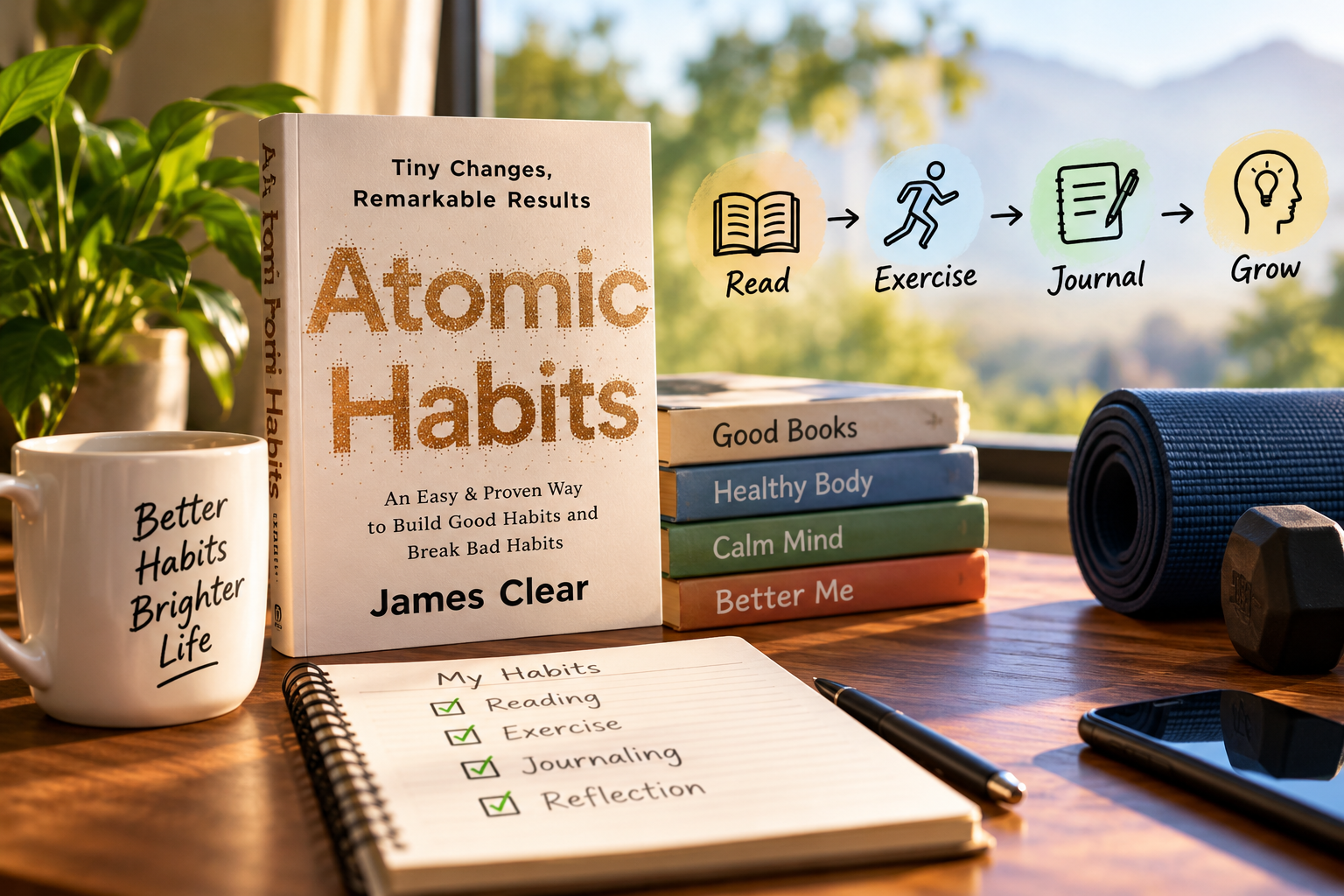
Most books fade within a week of finishing them. You close the last page, feel inspired for a few days, and then life quietly pulls you back to exactly who you were before.
I read Atomic Habits by James Clear two and a half years ago. I still haven’t put it down — not literally, but its ideas never left. They took over how I read, how I exercise, how I journal, and how I think about progress.
This isn’t a book review. It’s a real-life case study of what happens when you actually apply the Atomic Habits system for years instead of just reading it once and moving on. Here’s exactly what changed, with the numbers to prove it.
The Problem Before Atomic Habits: I Could Start Habits, But Never Continue Them
Before this book, my pattern looked the same every time:
- Decide to build a new habit
- Follow it for 4–7 days, maybe a month
- Life interrupts — laziness, busyness, one bad day
- The habit quietly disappears
- Months pass before I try again
For years, I blamed myself — my genetics, my willpower, my personality. What I didn’t understand is that motivation was never the missing piece. A system was. That single realization is the foundation of everything James Clear teaches, and it’s where my transformation actually started.
Goals vs. Systems: The Atomic Habits Principle That Changed Everything
The biggest mindset shift I took from Atomic Habits: a goal tells you where you want to go, but a system determines what you actually repeat every day.
I stopped asking “How do I read more?” and started asking “What system makes reading almost automatic?” That’s a small change in wording, but it leads to a completely different kind of behavior change.
A good life isn’t built from one big habit. It’s built the way a machine runs — from dozens of small, unglamorous parts working together at once.
The Two-Minute Rule: How to Build Habits That Actually Stick
The two-minute rule is one of the simplest ideas in the book, and also one of the most effective: make any new habit so small it’s almost impossible to refuse.
On good days, I read for an hour. On bad days — tired, unmotivated, drained — I tell myself: just read one paragraph.
Sometimes that’s all I read. Sometimes it turns into thirty pages. Either way, the habit survives the day. One paragraph today, another tomorrow, another the day after — eventually that becomes hundreds of pages. The size of the action barely matters. What matters is that the habit doesn’t die.
Habit Tracking: The Real Benefit Nobody Tells You About
I didn’t realize how much I’d actually accomplished until I started habit tracking. A single day of exercise feels like nothing. Hundreds of days, stacked together, tell a completely different story.
| Habit | Streak/Total |
|---|---|
| Morning stretching & Exercise | 366 consecutive days |
| Morning reading | 600 days |
| Evening journalling | 250 days |
| Daily reflection | 210 days |
These numbers aren’t the point. What they represent is a person who once couldn’t hold a habit for a week — who now has years of proof that he keeps promises to himself.
The Streak Effect: Why Breaking the Chain Feels Impossible Now
Once a streak gets long enough, something shifts psychologically — you stop wanting to go back to zero.
Before, missing one day used to snowball into missing a week, then months. Now, if I don’t feel like exercising, the deal is: at least walk for five minutes. If I don’t feel like reading, it’s one paragraph.
The goal stopped being perfection. It became continuity. That one distinction has done more for my consistency than anything else in this article.
Environment Design: Make Good Habits Obvious and Easy
James Clear’s advice to make good habits obvious and easy to start — I took very literally:
- Yoga mat left out where I’ll see it first thing
- Shoes placed by the door, ready to go
- Book left open on the desk, not buried in a bag
The environment does the negotiating for you. I’m not fighting laziness every morning — I removed the friction before the decision even had to happen. Discipline gets easier when your surroundings already point you toward the habit.
Habit Stacking Examples From My Own Routine (Plus My Own Twist: “Back Stacking”)
Habit stacking means attaching a new habit to one you already do automatically. Mine looks like this:
Wake up → drink water → read → exercise
Each habit becomes the trigger for the next one, so I don’t have to think through the whole routine — just the first domino.
I later built my own variation, which I call “back stacking.” Instead of just chaining habits forward, I use the next activity as a deadline for the current one. Knowing my workout is waiting right after reading makes me read with more focus, because I don’t want to eat into that next block. It’s a small, useful pressure that kills procrastination in the in-between moments of the day.
(This isn’t a term from the book — it’s something I built after applying James Clear’s principles long enough to find my own variation.)
Small Rewards, Big Momentum
The reward doesn’t need to be big. For me, it’s often just the checkmark on my habit tracker.
That tiny hit of satisfaction creates a loop: do the habit → track it → feel good → want to repeat it. Over time, the habit stops feeling like something you’re forcing and starts feeling like something you’re chasing.
The Real Proof: From Struggling to Finish 1 Book to Completing Over 20
Before this transformation, finishing a book was rare for me. I’d start strong, lose momentum, and abandon it halfway.
Since applying these principles, I’ve completed more than 20 books beyond Atomic Habits itself — plus multiple courses and skills I previously would have quit. The difference was never motivation. It was a system that made continuing easier than quitting.
The Domino Effect: How One Habit Rewired My Identity
I never set out to overhaul my entire life. I just applied a few principles from one book.
But one consistent habit pulled the next one along with it. Reading became steady. Then exercise. Then journaling. Then reflection.
Somewhere in that chain, my identity shifted. I stopped trying to be someone who reads, exercises, and reflects — I just started being that person. That identity shift, more than any single habit, is the deepest thing this book gave me.
The Plateau of Latent Potential, Explained
Here’s the part nobody warns you about: most of the time, effort doesn’t look like progress.
You read, exercise, practice, reflect — and nothing dramatic happens. That’s not failure. It’s what James Clear calls the Plateau of Latent Potential — like an ice cube sitting at 25°F, 26°F, 27°F, staying solid the whole time, right up until 32°F, when it suddenly melts.
I still feel like I’m somewhere on that plateau — accumulating, learning, building, waiting for the compounding to become visible. That’s not discouraging anymore. It’s just what the process looks like from the inside.
What Atomic Habits Really Taught Me: Consistency Beats Everything
If I had to boil down two and a half years into one word, it’s consistency — not motivation, not intensity, not perfection.
There are still days I don’t want to read, exercise, or journal. The system doesn’t remove that resistance. It just gives me a way to keep going anyway — because missing one day is fine, but letting one missed day become a permanent disappearance is the real danger.
Frequently Asked Questions
How does Atomic Habits actually change your life?
It replaces reliance on motivation with a repeatable system — small, obvious, easy actions that compound over months and years into major behavior change.
What is the two-minute rule in Atomic Habits?
Shrink any new habit down to something that takes two minutes or less to start, like “read one page” instead of “read for an hour.” The goal is to make starting effortless; momentum takes over from there.
What is habit stacking, and how do you use it?
Habit stacking means attaching a new habit to an existing one you already do without thinking, so the old habit triggers the new one — for example, “after I pour my coffee, I write three lines in my journal.”
How long does it take to build a habit that sticks?
There’s no fixed universal number of days — it depends on the habit and the person. What matters more than counting days is not breaking the chain of small repetitions long enough for the behavior to become automatic.
Why do habit trackers work?
Tracking makes invisible progress visible. A single day feels insignificant, but seeing dozens or hundreds of consecutive days creates a psychological pull to protect the streak instead of breaking it.
Final Thoughts: Don’t Just Read Atomic Habits — Build the System
You can read a book once, twice, or ten times and stay exactly the same person if you never act on it. Knowledge only becomes powerful once it’s turned into action.
Atomic Habits gave me the framework. But the transformation came from applying it in real life — obvious cues, small starts, stacked habits, tracked progress, small rewards, a supportive environment, and consistency over perfection.
I couldn’t hold a habit for a week when I started. Today I’m sitting on hundreds of consecutive days across four different habits. If that’s possible for me, the system is the reason — not talent, not willpower, not luck.
You don’t transform your life with one big change. You transform it with small, repeated ones — until they quietly become the system that shapes who you are.