
Have you ever finished a book and realized you’ll never look at your own mind the same way again?
That’s exactly what happened to me after reading Thinking Fast and Slow by Nobel Prize-winning psychologist Daniel Kahneman.
I’ll be honest—I almost gave up on this book several times.
Unlike most self-help books, Thinking Fast and Slow demands patience and concentration. Some chapters felt overwhelming, and I had to reread certain sections four or five times before I fully understood them.
But once everything started making sense, I realized this wasn’t just another psychology book. It was a guide to understanding how my own mind works.
I began noticing hidden biases, unconscious habits, and emotional reactions that had quietly influenced my decisions for years.
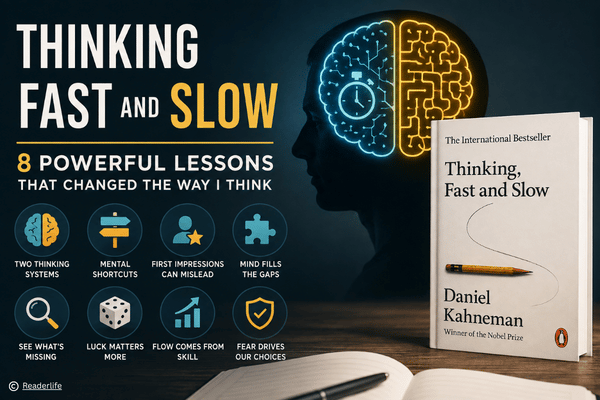
If you’re wondering whether Thinking Fast and Slow is worth reading, here are the eight lessons that had the greatest impact on my life.
Table of Contents
1. Your Brain Has Two Different Thinking Systems
The central idea of Thinking Fast and Slow is that our minds operate using two different systems.
System 1
- Fast
- Automatic
- Emotional
- Intuitive
System 2
- Slow
- Logical
- Analytical
- Deliberate
Before reading this book, I reacted almost instantly to situations.
Someone criticized me? I became defensive.
Something unexpected happened? I immediately worried about the worst possible outcome.
Now I consciously pause before reacting.
That small pause gives my logical mind enough time to evaluate the situation instead of allowing emotions to take control.
It has improved my relationships, reduced stress, and helped me make better decisions.
2. Your Brain Loves Mental Shortcuts
One concept that completely changed how I think was heuristics.
Heuristics are mental shortcuts the brain uses to make quick decisions.
Most of the time they are helpful.
But sometimes they lead us to poor judgments because we rely on incomplete information.
After learning this concept, I started noticing these shortcuts everywhere:
- Judging people within seconds
- Buying products because of a single positive review
- Making assumptions without enough evidence
Now, whenever I face an important decision, I ask myself:
Am I thinking carefully, or is my brain simply taking the easiest shortcut?
That single question has prevented many avoidable mistakes.
3. First Impressions Can Be Misleading
Another powerful lesson came from two psychological concepts:
Anchoring
The first piece of information we receive heavily influences every judgment that follows.
Halo Effect
One positive quality—such as confidence, attractiveness, or charisma—makes us assume someone is competent in every other area.
Earlier, I trusted my first impressions far too much.
Today, I remind myself that first impressions are often incomplete.
Instead of asking whether I like someone immediately, I ask:
What actual evidence do I have?
This simple shift has helped me judge people far more fairly.
4. Your Mind Creates Stories to Fill the Gaps
One uncomfortable realization from the book was how quickly the brain invents explanations.
Whenever information is missing, our minds naturally create a story that seems reasonable—even if it isn’t true.
I realized I had done this countless times.
Rather than admitting uncertainty, I confidently explained situations without sufficient evidence.
Now I’m much more comfortable saying:
“I don’t know yet.”
Surprisingly, accepting uncertainty has made my decisions stronger, not weaker.
5. We Often Ignore What’s Missing
One of the most memorable ideas in Thinking Fast and Slow is WYSIATI:
What You See Is All There Is.
Our brains build conclusions using only the information currently available while ignoring everything that’s missing.
This lesson transformed the way I make important decisions.
Before committing to anything significant, I ask myself:
- What information haven’t I considered?
- What assumptions am I making?
- What evidence might change my opinion?
These questions have helped me avoid many rushed decisions.
6. Luck Matters More Than We Like to Admit
This lesson challenged my ego.
Whenever I succeeded, I assumed it was entirely because of skill.
Whenever I failed, I blamed myself completely.
Daniel Kahneman explains regression to the mean, showing that unusually good or unusually bad outcomes are often followed by more average results.
In other words, luck influences our lives far more than we realize.
Today:
- I celebrate success without becoming overconfident.
- I accept setbacks without believing everything is ruined.
- I focus on consistent effort instead of short-term results.
That mindset has made me far more resilient.
7. Flow Comes From Skill, Not Motivation
Many people believe motivation creates productivity.
This book helped me see it differently.
Flow isn’t something you wait for.
It develops naturally when your skills become strong enough to handle meaningful challenges.
Instead of constantly searching for motivation, I now concentrate on improving my abilities.
As my competence increases, focus becomes easier and distractions disappear naturally.
The more skilled I become, the easier it is to enter a flow state.
8. Fear Often Drives Our Decisions
Perhaps the most practical lesson was loss aversion.
Human beings experience the pain of losing something much more intensely than the pleasure of gaining something of equal value.
Looking back, I realized how many of my decisions were driven by fear rather than logic.
Today, before making any important decision, I ask:
Am I avoiding this because it’s genuinely a bad idea, or simply because I’m afraid of losing?
That single question has improved both my financial decisions and my everyday judgment.
What Changed After Reading Thinking Fast and Slow?
Reading Thinking Fast and Slow didn’t change my personality.
It changed my awareness.
The biases, mental shortcuts, and emotional reactions described in the book were already influencing my life.
The difference is that I can now recognize them.
Once you recognize a cognitive bias, it becomes much easier to challenge it before it influences your actions.
That awareness alone has made me calmer, more patient, and more thoughtful.
Should You Read Thinking Fast and Slow?
If you’re looking for a light weekend read, this probably isn’t the right choice.
However, if you’re willing to read slowly, reflect deeply, and even revisit difficult chapters, Thinking Fast and Slow can permanently change how you approach decisions.
It isn’t just a book about psychology.
It’s a book about understanding yourself.
Also read: Entitlement and Happiness: Why Letting Go of Control Unlocks True Joy
Key Takeaways
Here are the biggest lessons I learned:
- Pause before reacting emotionally.
- Question your first impressions.
- Be aware of mental shortcuts.
- Don’t be afraid to say, “I don’t know.”
- Look for missing information before deciding.
- Recognize the role of luck alongside effort.
- Focus on building skills instead of chasing motivation.
- Choose logic over fear whenever possible.
Final Thoughts
The greatest lesson from Thinking Fast and Slow is simple:
Every day, we face a choice between reacting automatically and thinking deliberately.
The more often we activate our slower, analytical thinking, the better our decisions become.
If you’ve already read this book, I’d love to hear your experience.
Which lesson changed your thinking the most? Let me know in the comments below.