

In today’s fast-paced society, while communication is often instant, meaningful connections are more challenging to cultivate. As a result, trust has emerged as a valuable and increasingly rare form of currency in our relationships. Stephen R. Covey‘s influential book, The 7 Habits of Highly Effective People, presents an important concept called the Emotional Bank Account. This idea offers a framework for understanding how we build and maintain trust in our interactions with others, emphasising the significance of deposits and withdrawals in strengthening relationships.
Every relationship can be likened to a financial bank account, maintaining an emotional balance that is crucial for its health. Positive contributions, such as kindness, honesty, patience, and respect, serve as deposits that enhance trust within the relationship. Conversely, adverse actions, such as disrespect, neglect, or broken promises, serve as withdrawals that erode this trust. Recognising and understanding this metaphorical account can significantly influence how individuals interact with their partners, friends, family, and colleagues, fostering healthier and more fulfilling relationships.
Table of Contents
The Meaning Behind the Emotional Bank Account

Stephen Covey presents the concept of the Emotional Bank Account as a metaphor illustrating how trust develops in our relationships over time. Each interaction we have can be viewed as a transaction that affects our trust balance. Positive actions—such as keeping promises, demonstrating genuine concern, and actively listening—are considered deposits that enhance our trustworthiness. Conversely, negative behaviours like breaking trust, expressing anger, or acting selfishly are seen as withdrawals that diminish the trust we’ve built.
Emotional currency, in contrast to monetary wealth, does not accrue interest on its own. It necessitates continuous attention and intentional effort. A single grand gesture is not sufficient to ensure that trust remains intact indefinitely. Instead, relationships flourish through the accumulation of small, consistent deposits of care and communication over time.
The Power of Emotional Deposits
Contributions to the Emotional Bank Account consist of behaviours that help individuals feel appreciated and honoured. These gestures don’t have to be elaborate; frequently, the tiniest expressions hold the most tremendous significance.
For instance:
- Taking time to listen when someone talks honestly.
- Remembering small details that matter to them.
- Apologising sincerely when you’re wrong.
- Being dependable and doing what you said you’d do.
Each of these moments adds to the balance. And when the account is strong, it builds a robust foundation where communication flows easily and misunderstandings are resolved faster.
Maintaining a strong balance in relationships is crucial. When trust is high, individuals can afford to make occasional mistakes without jeopardising the connection; this is often referred to as a “trust reserve.” However, when the trust level is low, even minor misunderstandings can lead to significant negative consequences. It highlights the importance of nurturing trust to prevent conflicts and maintain healthy relationships.
The Cost of Withdrawals
Just as deposits strengthen relationships, withdrawals weaken them. Harsh words, broken promises, or simply taking someone for granted can quickly empty the Emotional Bank Account.

It is crucial to recognise that not all withdrawals from a relationship are deliberate. Often, neglect can inadvertently erode trust. When individuals fail to acknowledge the efforts of others or overlook their feelings over time, it can lead to a build-up of emotional debt. This emotional debt can gradually undermine the relationship, causing significant internal damage.
Stephen Covey emphasises that when trust is compromised, rebuilding it is not an immediate process. It requires consistent and sincere actions to repair the trust that has been lost. Although forgiveness may occur, restoring the emotional balance takes time and effort.
The Role of Trust in Every Relationship
Trust serves as a vital component of strong relationships, acting as the emotional capital that underpins effective communication. In the absence of trust, interactions can become forced and defensive, inhibiting open dialogue. Conversely, when trust is present, conversations tend to flow more naturally.
The concept of the Emotional Bank Account illustrates that when this account is complete, individuals can engage in discussions about complex issues without fear of judgment. This creates an environment where both parties feel safe to express themselves honestly, facilitating more profound and meaningful connections.
In family dynamics, a high level of trust fosters a sense of security for children, respect among partners, and enables the resolution of disagreements with empathy. Similarly, in workplace settings, trust promotes collaboration and openness and encourages innovation.
Overall, the principle remains consistent across various contexts: trust not only strengthens relationships but also cultivates a sense of freedom in communication and interaction.
Six Key Ways to Build a Strong Emotional Bank Account
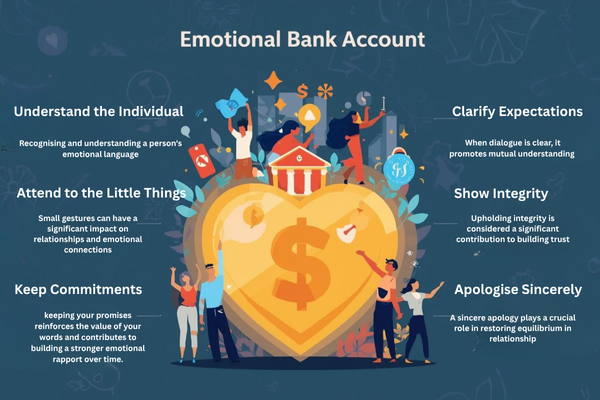
Stephen Covey outlined several principles to help maintain and grow this emotional balance. Here’s how they translate into everyday life:
1. Understand the Individual
Individuals prioritise different values, so what one person perceives as a meaningful contribution may hold little significance for another. Recognising and understanding a person’s emotional language—specifically, what makes them feel loved, respected, or appreciated—is essential for making impactful emotional deposits in relationships. This understanding serves as the foundation for building deeper connections.
2. Attend to the Little Things
Small gestures can have a significant impact on relationships and emotional connections. Simple actions such as sending a text that says “I was thinking about you,” offering a sincere “thank you,” or assisting without being asked can serve as meaningful expressions of care and support. These acts contribute positively to what is often referred to as an Emotional Bank Account, highlighting the importance of nurturing emotional bonds through thoughtful interactions.
3. Keep Commitments
Broken promises can significantly undermine trust. When you commit to something, it is essential to follow through on that commitment. Consistently keeping your promises reinforces the value of your words and contributes to building a stronger emotional rapport over time.
4. Clarify Expectations
Conflicts frequently arise from a lack of clarity rather than from any malicious intent. Engaging in open communication regarding individual needs and expectations can help avoid misunderstandings and enhance relationships. When dialogue is clear, it promotes mutual understanding and can effectively prevent unnecessary tensions.
5. Show Integrity
Integrity refers to the practice of aligning one’s actions with personal values, regardless of external observation. Upholding integrity is considered a significant contribution to building trust and credibility within any relationship, often referred to as an “Emotional Bank Account.” Acting with integrity fosters deeper connections and enhances overall interpersonal dynamics.
6. Apologise Sincerely When You’re Wrong
A sincere apology plays a crucial role in restoring equilibrium in relationships. It recognises and validates the hurt experienced by the other party without offering excuses. Stephen Covey highlights the importance of humility and vulnerability in this process, suggesting that these qualities can often contribute more meaningfully to resolution than striving for perfection.
How Emotional Bank Accounts Impact Communication
Trust plays a critical role in communication dynamics. When trust levels are high, interactions can proceed smoothly, even in the face of disagreements. Individuals feel free to share their honest opinions without the fear of being judged or facing negative consequences. In these scenarios, people engage in conversations not out of obligation, but from genuine interest.
Conversely, when the Emotional Bank Account is depleted, communication becomes defensive and strained. Under such circumstances, every statement may be perceived through a lens of suspicion, causing even neutral comments to be interpreted as criticism. Therefore, it is essential to focus on rebuilding this balance through the components of empathy, honesty, and patience. Restoring trust is vital for fostering clear and constructive dialogue moving forward.
Rebuilding After Withdrawals
Relationships are not immune to challenges; imperfections are a natural part of human connection. Miscommunication, broken promises, and hurt feelings can occur, making it essential to consider how to respond effectively when these setbacks happen.
Rebuilding what is often referred to as an Emotional Bank Account begins with taking responsibility for one’s actions. Acknowledging mistakes without shifting blame is crucial. Subsequent positive actions must be consistent to restore trust over time, ultimately leading to a healthier balance in the relationship.
Forgiveness is a process that cannot be hurried, but consistent efforts can significantly impact healing. Engaging in genuine positive interactions—such as actively listening, being present, and honouring commitments—demonstrates to the other party that the relationship remains essential and valued.
Emotional Bank Account in Professional Life
The concept of the Emotional Bank Account, introduced by Stephen Covey, is primarily associated with personal growth but has significant implications in the professional realm as well. In a workplace setting, emotional trust is a crucial component that shapes team culture and the effectiveness of leadership.
Leaders who consistently keep their commitments, communicate openly, and prioritise the well-being of their employees contribute to building teams with firm emotional reserves. When team members feel secure, they are more likely to share innovative ideas, take calculated risks, and express their true selves.
Conversely, organisations that experience frequent emotional withdrawals—such as micromanagement, a culture of blame, or unfulfilled promises—tend to cultivate an environment of fear and disengagement among employees. Ultimately, the overall culture of a company reflects the collective emotional balance of all its relationships.
Also read: Life-Changing Lessons from The 7 Habits of Highly Effective People
Long-Term Investment: Maintaining the Balance

When considering relationships, it can be helpful to view them as long-term investments. Just as with any investment, you cannot make a single deposit and then neglect it; ongoing engagement is essential, even during everyday interactions.
The focus in nurturing these relationships should not be on achieving perfection but rather on demonstrating intention. Each time an individual chooses to exercise empathy over ego, listens rather than reacts, or appreciates instead of makes assumptions, they are contributing to what is often referred to as the Emotional Bank Account.
This consistent effort to make ‘deposits’ into the relationship not only helps to maintain harmony but also fosters resilience. When challenges arise—an inevitable part of any relationship—the emotional trust and connection built through these interactions serve as a crucial support system.
The Takeaway: Trust Is Earned, Not Assumed
Stephen Covey’s concept of the Emotional Bank Account emphasises that trust is not something that comes automatically; rather, it is something that must be earned and nurtured through consistent and caring behaviours. Every interaction we have can either enhance or diminish the trust we share with others.
We maintain emotional accounts with various individuals in our lives, including parents, partners, colleagues, and friends. Each of these relationships requires continuous attention and care. By actively making deposits of kindness, honesty, and empathy, we foster relationships that not only endure but flourish over time.
It’s valuable to reflect on our interactions with others by considering whether our actions are making a deposit or a withdrawal. Ultimately, strong relationships are not formed through grand gestures but are built through consistent, small deposits into the essential and intangible Emotional Bank Account.